Architecture
How it's built
How the gateway is put together, in four pictures: the gateway as a whole, one request's path through the proxy, the audit chain with its daily anchor, and how each published number is produced. Select a diagram to open it full size.
The system
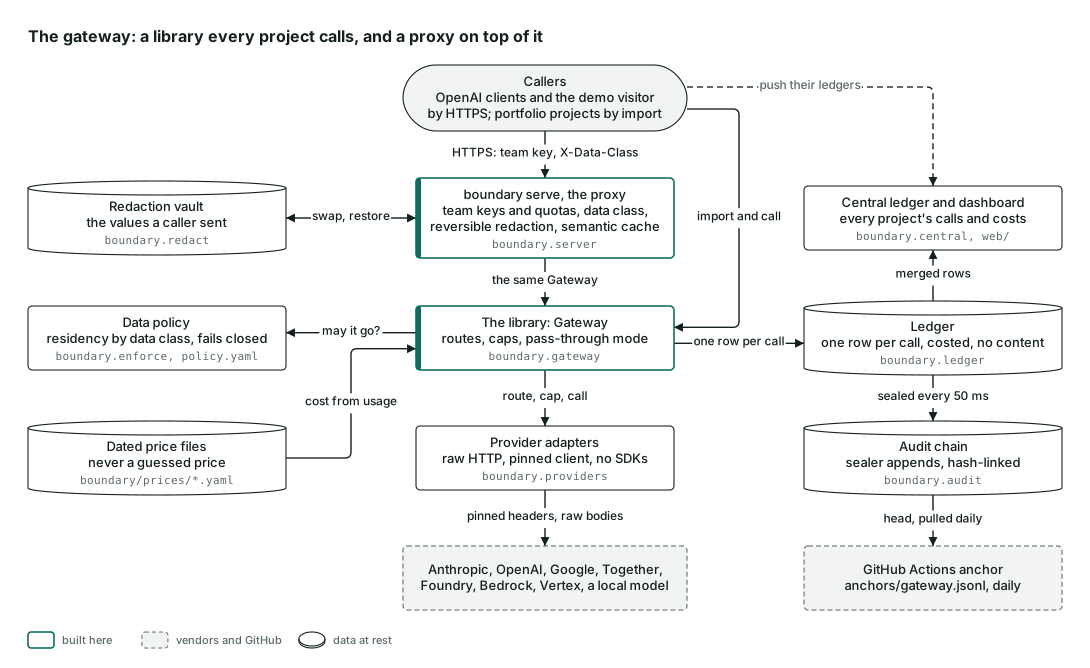
Two kinds of caller reach the same gateway. The portfolio's own projects import it as a library and call it directly. Everyone else, including any OpenAI-compatible client and anyone using the published demo key, calls the proxy over HTTPS with a team key and a header declaring what kind of data the request holds. The proxy hands the request to the same gateway, so a call made either way leaves exactly the same record.
The proxy adds what the library cannot decide on its own: who is calling and what they are allowed, what the data is, the swapping of personal details for placeholders and back, and a cache of earlier answers.
The gateway itself asks the data policy whether that kind of data may go to the chosen vendor, and refuses when it may not. It checks the spending caps and sends a plain HTTP request to the vendor, with no vendor software in between. It works out the cost from the usage the vendor reports and a dated price list, never a guess, and writes one row to the ledger. A separate process adds each finished row to a tamper-evident chain, and a GitHub workflow copies the chain's latest fingerprint into this repository every day. Every project's ledger is merged into the central one behind the dashboard.
Where it lives: boundary.gateway, boundary.server, boundary.enforce, boundary.providers, boundary/prices/, boundary.ledger, boundary.audit and boundary.central.
One request through the proxy
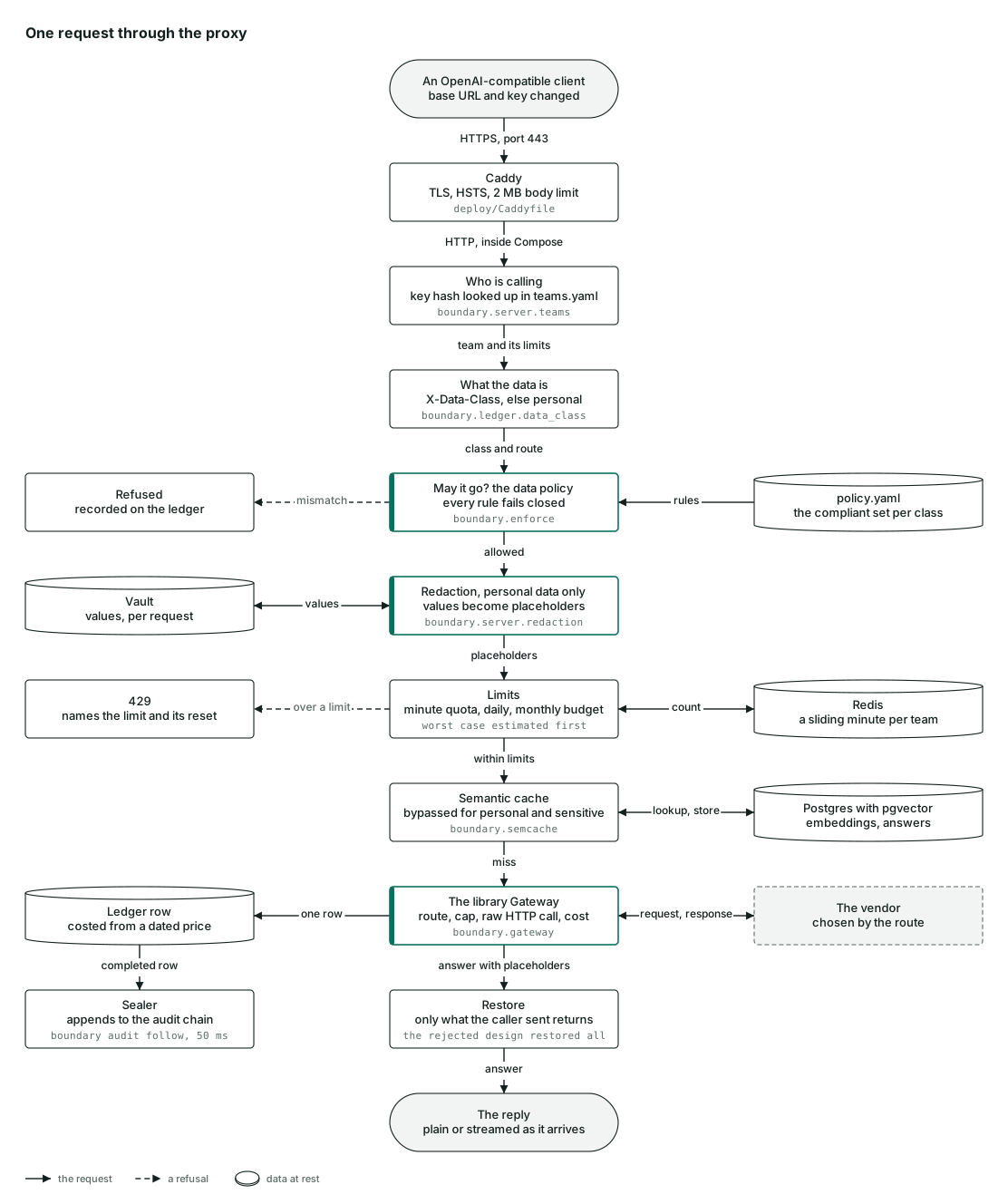
This is what happens when you press the demo button, or when any client calls the proxy.
The web server in front handles the secure connection and limits the request's size. The request is identified by its team key. Its declared kind of data is read, and a request that declares nothing is treated as personal, the safest assumption. The data policy then decides whether it may go to the chosen vendor. Every rule fails closed: if the answer is no, the request is refused and the refusal is recorded.
Personal details are swapped for placeholders, and the real values are held for this request only. The team's limits are checked before the call, using the worst case the call could cost: a per-minute rate, and daily and monthly budgets. A request over a limit is refused with a message naming the limit and when it resets.
Only requests with public data may be answered from the cache of earlier answers. On a miss, the gateway calls the vendor and writes the costed ledger row, which joins the audit chain within 50 milliseconds. The answer comes back with only the values this caller sent put back in place. An earlier design put every value back, and a test showed that leaked, so it was rejected. The answer is returned whole or streamed as it arrives.
Where it lives: deploy/Caddyfile, boundary.server.teams, boundary.enforce, boundary.server.redaction, boundary.redact and boundary.semcache.
The audit chain and the daily anchor
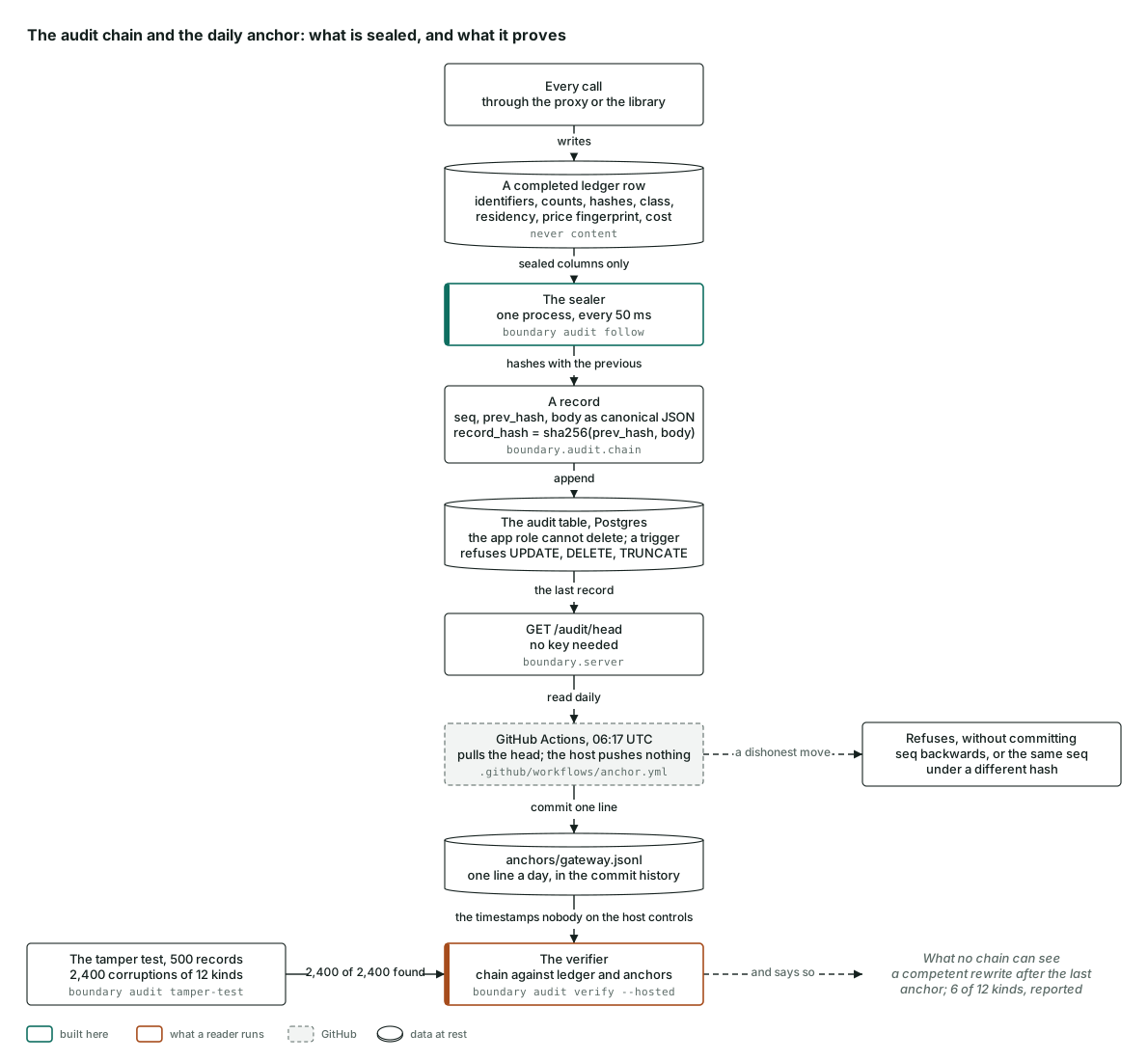
Every call writes a ledger row. It holds identifiers, counts, fingerprints, the declared kind of data and where it was processed, the price list used, and the cost. It never holds the content of the request or the answer.
A single process turns each finished row into a link of a chain. Each link carries a sequence number with no gaps, the previous link's fingerprint, and its own fingerprint computed over both, so changing any earlier link breaks every link after it. The chain lives in a database table the proxy cannot delete from, and a database rule refuses any edit or deletion, even by the table's owner.
The chain's latest link is public, with no key needed. Every morning at 06:17 UTC a GitHub workflow reads it and commits one line to this repository, so GitHub's history becomes a timestamp nobody on the server controls. The server pushes nothing and holds no credential that could write here. The workflow refuses to commit if the chain moves in a way an honest chain never does, such as the sequence going backwards or the same number reappearing with a different fingerprint.
A verifier checks the chain against the ledger and those daily anchors. A tamper test corrupts a 500-link chain 2,400 times, in twelve different ways, and reports what the verifier finds. The six kinds of tampering no chain can detect after its last anchor are reported beside the ones it catches.
Where it lives: boundary.audit.chain, .github/workflows/anchor.yml and anchors/gateway.jsonl.
How the published numbers are produced
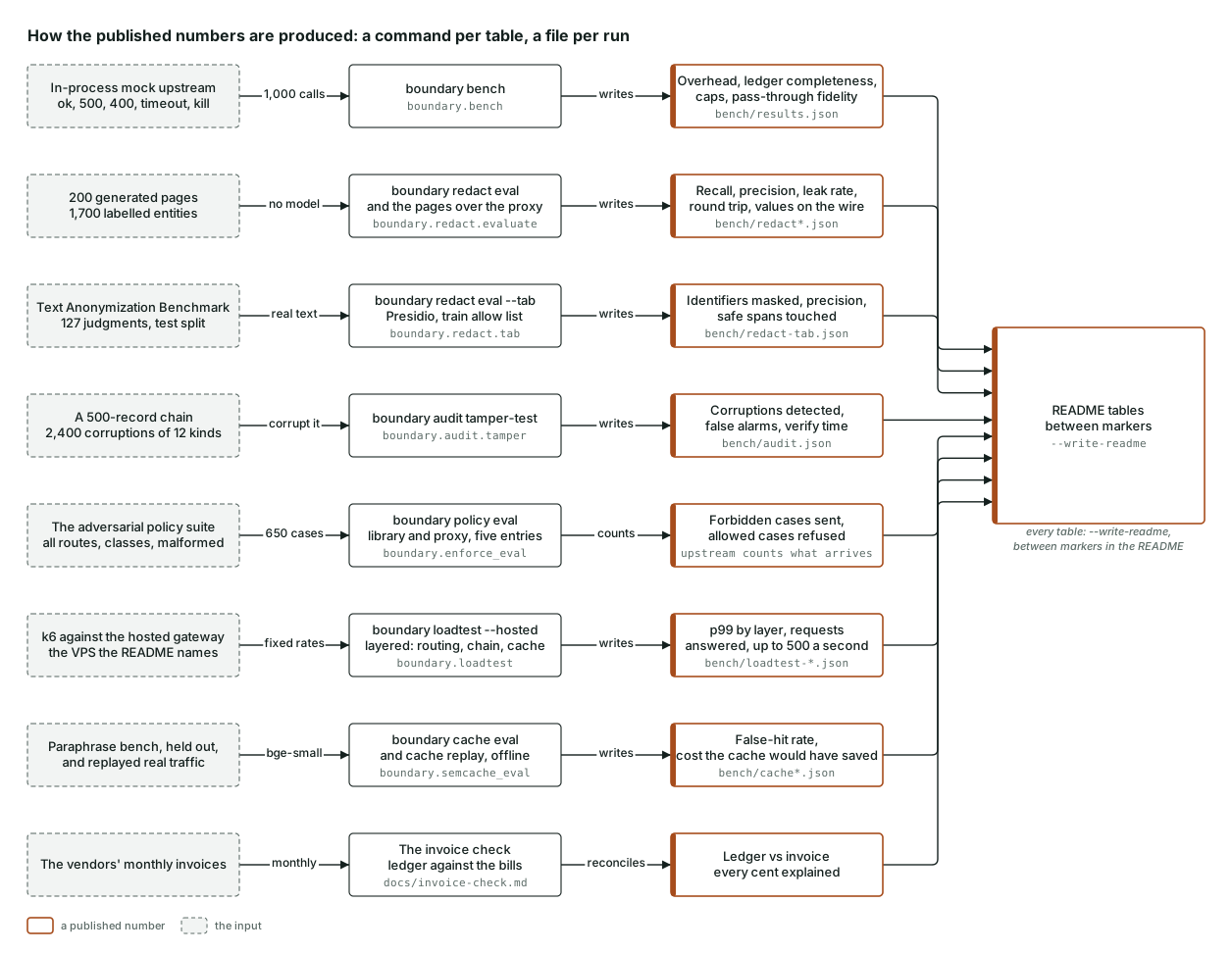
Every table in the README has one command, one stated input and one stored result. This is how each one is made.
The gateway's own overhead, whether the ledger misses calls when things fail, whether calls get past a spending cap, and whether requests pass through unaltered are all measured against a stand-in vendor running on the same machine. Redaction is scored on 200 generated pages holding 1,700 labelled personal details, with no AI model involved, so anyone can rerun it offline. The same pages are then sent through the proxy, and the personal details that reached the vendor are counted. Redaction is also scored on a public benchmark of 127 court judgments, the way that benchmark's own script scores it.
The tamper test corrupts a 500-link chain 2,400 times. The policy test sends every combination of vendor and kind of data, including none and malformed ones, through all five ways in, and counts what reaches a stand-in vendor. The load test runs against the live gateway on its server, one layer at a time. The cache is scored offline, on held-out paraphrases and on replayed real traffic. Once a month the merged ledgers are reconciled against the vendors' own bills.
Each command writes its own table into the README, so a reader can rerun any of them.
Where it lives: boundary bench, boundary redact eval, boundary audit tamper-test, boundary policy eval, boundary loadtest, boundary cache eval and the results in bench/.